

Regulatory Affairs in India can make or break how quickly a medical device reaches patients, and nowhere is that more visible than in the CDSCO approval process. Manufacturers who treat compliance as an afterthought often watch their launch timelines slip by months. However, companies that build a disciplined regulatory strategy from day one tend to move through the system far faster, and with fewer costly surprises along the way.
What Regulatory Affairs in India Actually Involves
At its core, this field covers classification, documentation, licensing, and post-market compliance under the Medical Device Rules. Teams handling this work must track everything from device risk class to labeling requirements, since even small gaps can trigger a query from CDSCO. Additionally, the rules are updated periodically, so staying current is not optional — it’s a continuous responsibility. Many manufacturers underestimate how much cross-functional coordination this requires, since quality, clinical, and legal teams all feed into a single submission.
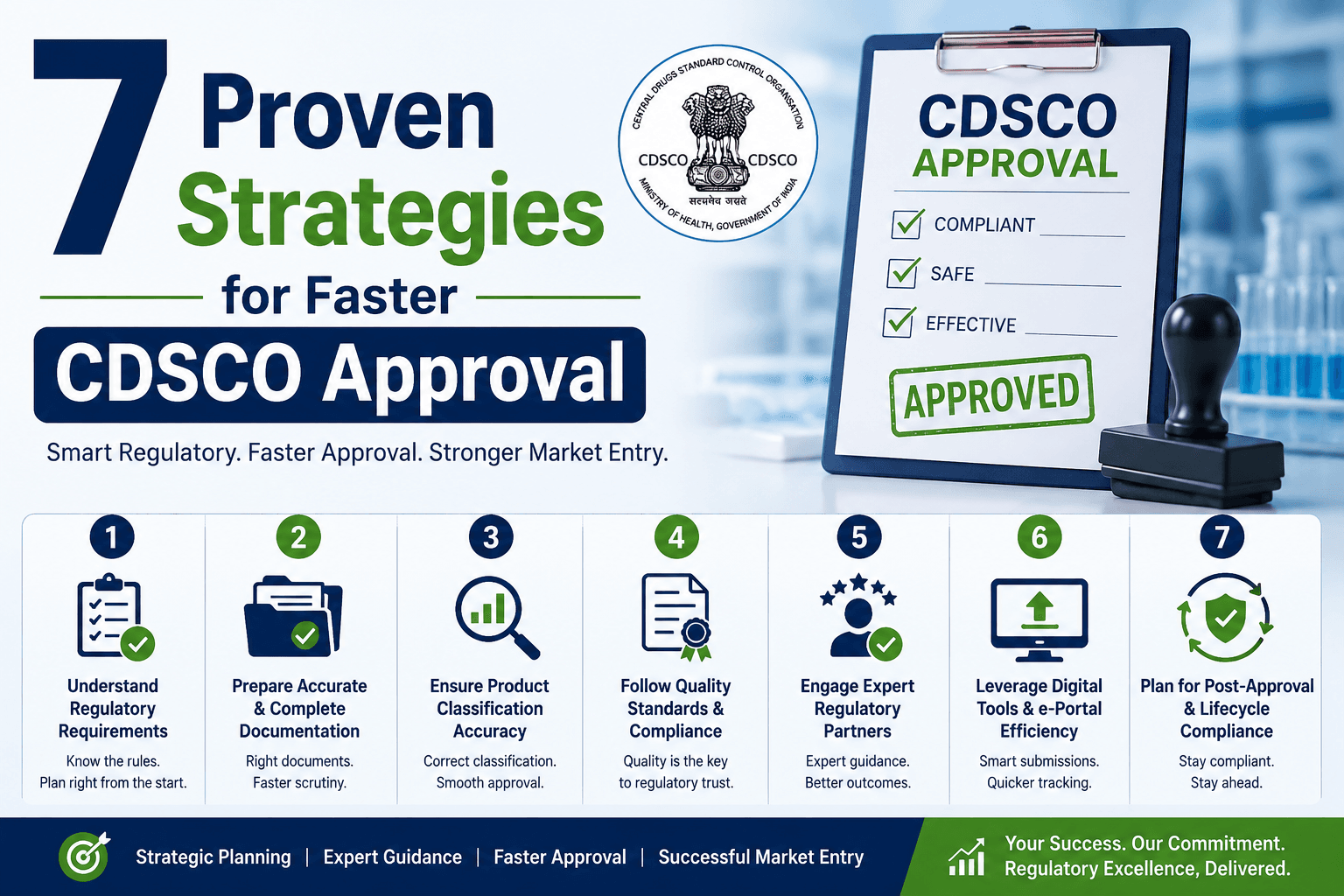
7 Proven Strategies for Faster CDSCO Approval
The following strategies consistently shorten review timelines for manufacturers navigating this process:
- Classify the device correctly upfront. A wrong risk classification is one of the most common causes of rejection and rework.
- Prepare a complete technical file the first time. Incomplete dossiers trigger deficiency letters, therefore adding weeks or months to the timeline.
- Engage an Authorized Indian Agent early. Foreign manufacturers need this in place before submission, not after.
- Align labeling with Indian requirements. Local language and formatting rules differ from other markets, so don’t assume a global label will pass as-is.
- Track query timelines closely. Fast, complete responses to CDSCO queries prevent files from stalling in the queue.
- Use a quality management system built for Indian audits. This reduces friction during site inspections and post-market checks.
- Work with experienced regulatory consultants. Specialists who understand local requirements can flag issues before submission rather than after.
Common Delays in the CDSCO Approval Process
Most delays come down to a handful of recurring issues: missing test reports, mismatched device master files, and unclear predicate comparisons. As a result, applications bounce back for clarification instead of moving forward. Consequently, manufacturers who audit their submission against CDSCO’s own checklist before filing tend to avoid the slowest part of the process entirely. A second common trap is underestimating how long site inspections and query cycles can stretch a timeline, particularly for higher-risk device classes.
How Long Does CDSCO Approval Typically Take?
Timelines vary by device class, but manufacturers with a clean submission and a well-organized technical file generally move through review faster than those who file incomplete dossiers. Class A and B devices tend to move through notified-body pathways more quickly and predictably, while higher-risk Class C and D devices face closer scrutiny and noticeably longer review cycles. Companies new to this process are often surprised by how much of the timeline depends on their own responsiveness rather than CDSCO’s internal processing speed. Every query round adds days or weeks, so the fastest manufacturers are usually the ones who prepared thoroughly before submitting. Building in buffer time for one query cycle is realistic, even for a strong application.
Building a Long-Term Regulatory Strategy
Faster approval is only half the goal. A sound approach to Regulatory Affairs in India also protects a device once it’s on the market, covering vigilance reporting, license renewals, and change notifications. For deeper guidance on structuring this end-to-end, our medical device registration services page walks through the full process step by step. For the latest official requirements, manufacturers should also review guidance directly from the Central Drugs Standard Control Organisation. Checking primary sources regularly helps teams catch rule changes before they affect a pending submission.
Ultimately, treating this work as an ongoing discipline rather than a one-time hurdle is what separates manufacturers with smooth, predictable launches from those stuck in repeated review cycles. A well-run regulatory strategy pays for itself many times over in time saved and risk avoided.